


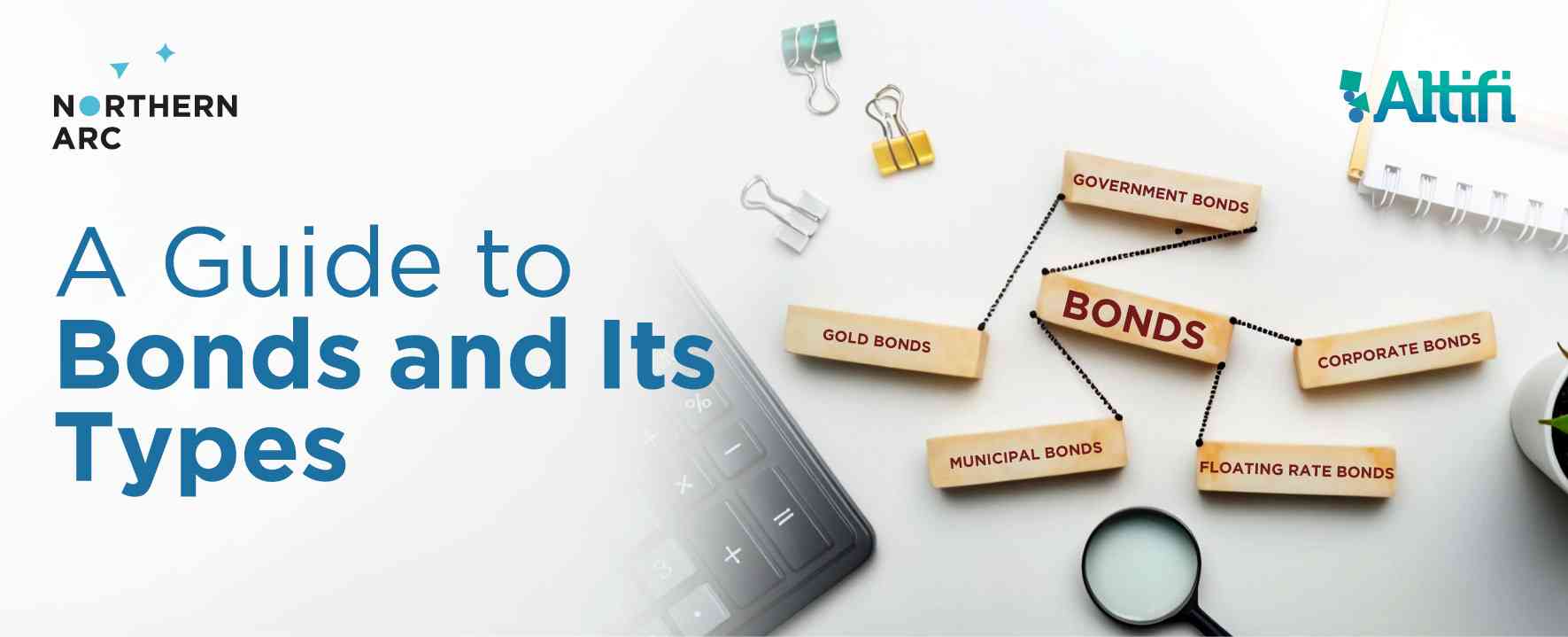
As an investor, you can invest in many financial instruments to grow and preserve your money. One such type of instrument you may consider is bonds. Investing in bonds can be a suitable choice to get predictable returns while diversifying your investment portfolio. Bonds may often be considered safe, as they offer a steady income stream and help preserve capital. There are a range of bond types available, and each comes with its own set of features and benefits. This variety allows you to choose bonds that align with your financial goals and risk tolerance. This blog talks about the different types of bonds to help you make informed investment decisions.
Understanding Bonds
Bonds are fixed-income financial instruments that represent a loan made by an investor to a borrower. The borrower typically being a government or corporation. When an entity issues a bond, it essentially borrows capital from investors in exchange for periodic interest payments. Bonds are generally used to raise funds for specific projects or operational needs. The terms of the bond, including the interest rate and maturity date, are defined at the time of issuance. Bonds are typically less volatile and tend to offer predictable returns.
Features of Bonds
Bonds have several key features that define their structure and behaviour in the financial market:
- Issuer: The bond issuer is the entity that borrows money from investors in exchange for issuing bonds. Issuers can include central and state governments, municipal corporations, financial institutions, banks, public sector units and private or public companies. Each type of issuer has its own risk profile which is evaluated by credit rating agencies.
- Face Value: The face value or par value is the bond’s nominal value as declared by the issuer at the time of issuance. It is the amount that will be paid back to the bondholder upon the bond’s maturity. The face value may differ from the bond’s market price during trading.
- Price of Bond: The price of a bond refers to the amount at which the bond is currently traded in the secondary market. The bond price fluctuates based on various factors such as interest rate changes, credit ratings and market demand.
- Coupon Rate: The coupon rate is the interest rate paid by the issuer to the bondholder. This rate is typically fixed but can vary based on the type of bond, the issuer’s creditworthiness and prevailing economic conditions. The coupon payments are usually made monthly, semi-annually, quarterly or annually depending on the terms of the bond
- Maturity: Bonds have a set maturity date when the issuer returns the principal amount to the bondholder. They are categorised as short-term or long-term based on their maturity period.
- Credit Rating: Credit rating agencies assign each bond a credit rating to reflect the issuer's capability to meet its debt obligations. Bonds with higher ratings, like AAA, indicate relatively lower risk and generally offer lower yields. In contrast, bonds with lower ratings may carry relatively higher risk but may also provide potentially higher returns.
- Yield: The yield of a bond represents the return an investor earns from holding the bond. It is assessed by considering both the coupon payments and any price changes. Yield to maturity (YTM) is the overall return an investor can expect if the bond is held until it matures. It is affected by factors like the bond’s face value, coupon rate, current market price and the time left until maturity.
Types of Bonds
Bonds come in various types, each catering to different investment goals and risk profiles. Here is an overview of the key types of bonds:
Government Bonds
Government bonds are debt securities issued by central or state governments to finance public projects and manage national debt. These types of bonds are considered low-risk investments due to the backing of the government. They typically offer fixed interest rates and have various maturities, making them a stable option for investors seeking reliable returns. Government bonds are typically favoured for their safety and relatively lower risk of default.
StateDevelopment Loans (SDLs)
State Development Loans (SDLs) are types of bonds that are issued by state governments in India to fund infrastructure and development projects in the state. SDLs are backed by the creditworthiness of the issuing state rather than the central government.
STRIPS – Separate Trading of Registered Interest and Principal of Securities
STRIPS are a type of zero-coupon bond created by separating the interest payments and principal repayment of a traditional bond. Each interest payment and the principal repayment are sold as separate securities. STRIPS do not make periodic interest payments but are sold at a discount and redeemed at face value upon maturity.
Sovereign Gold Bonds
Sovereign Gold Bonds are issued by the Government of India as an alternative to physical gold investments. These types of bonds are denominated in grams of gold and offer returns based on the gold price, plus an additional fixed interest rate. Investors benefit from the appreciation of gold prices and receive periodic interest payments. Sovereign Gold Bonds also come with tax benefits and are considered a secure investment option to invest in gold without the hassle of storing physical gold.
Corporate Bonds
Corporate bonds are debt securities issued by companies to raise capital for various business needs, such as expansion, acquisitions or operational expenses. These bonds may typically offer high yields and potential higher risk depending on the issuer's creditworthiness. Corporate bonds can be classified into different types based on their interest rate structure, risk profile and convertibility features, catering to various investor preferences.
Fixed Rate Bonds
Fixed rate bonds provide a set interest rate that remains unchanged for the bond's duration. You can receive regular coupon payments based on this fixed rate, providing a predictable income stream. These types of bonds are advantageous in stable or declining interest rate environments but may be less attractive when market rates fluctuate, as new bonds may offer higher yields.
Floating Rate Bonds
Floating rate bonds have an interest rate that adjusts periodically based on a reference benchmark, such as MIBOR or the repo rate. This feature protects you from interest rate fluctuations, as the coupon payments increase when market rates rise and decrease when rates fall. Floating rate bonds are suitable for investors who expect interest rates to rise or who want to hedge against inflation. They offer potentially higher returns in a rising interest rate environment.
Inflation Indexed Bonds
Inflation indexed bonds offer returns adjusted for inflation. They provide interest payments and principal repayments that increase with the inflation rate, ensuring real returns are preserved. These bonds are ideal for investors concerned about inflation eroding the value of their investments.
Callable/Puttable Bonds
Callable bonds grant the issuer the right to redeem the bond before its maturity date, allowing the issuer to refinance at lower rates. Callable bonds generally offer higher coupon rates to compensate for this risk. Conversely, puttable bonds give investors the right to sell the bond back to the issuer at predetermined dates. Puttable bonds are more flexible and are advantageous if interest rates rise, as they can be sold back before maturity at a known price.
Convertible Bonds
Convertible bonds are hybrid securities that combine the features of bonds with the option to convert them into a predetermined number of the issuer's shares. This conversion feature allows you to benefit from potential equity appreciation while still receiving regular interest payments until conversion.
Zero Coupon Bonds
Zero coupon bonds are sold at a price lower than their face value and do not provide regular interest payments. Instead, they are redeemed at full face value when they mature. The profit comes from the difference between the buying price and the maturity value, which represents the interest earned.
High-Yield Bonds
High-yield bonds are issued by companies with lower credit ratings and, therefore, carry a higher risk of default compared to investment-grade bonds. To compensate for this increased risk, high-yield bond issuers tend to offer higher interest rates. High-yield bonds attract investors with the potential for higher returns. However, you ought to consider the increased credit risk associated with these securities.
Municipal Bonds
Municipal bonds are issued by local government entities, such as cities, counties or states, to fund public projects like infrastructure and hospitals. They are considered low-risk investments as they are backed by the issuing municipality's taxing power or revenue-generating projects. Municipal bonds may offer tax advantages, as interest income is exempt depending on the bond’s conditions and applicable laws.
Green Bonds
Green bonds are issued to fund environmentally sustainable projects, such as renewable energy, clean transportation, or water conservation. Green bonds are issued by various public and private sector entities to finance initiatives that align with the country’s environmental goals.
Advantages of Bonds
Bonds are often chosen by people who want safer and more stable investments. Here’s why they are useful:
Less risky than stocks:
Prices do not change as much as shares, so they feel more stable.
Your money is safer:
If you stay invested till the end, you usually get your full amount back.
Balances your portfolio:
Adding bonds can reduce risk if you already invest in stocks.Many options available:
You can choose bonds based on time period, returns, and who is issuing them.Overall, bonds may be a good choice for people who prefer stability over high risk.
Limitations of Bonds
Bonds are not perfect and come with few downsides:
Returns are lower:
Compared to stocks, bonds usually give lower returns. They focus more on steady income than on high growth over time.
Interest rate changes affect prices:
When interest rates go up, bond prices fall. This happens if newer bonds offer better returns than older ones.
Risk from issuer:
Sometimes, the issuer may face problems in paying back money. This risk is higher if the issuer is not financially strong.
Not always easy to sell:
Some bonds cannot be sold quickly before maturity. You may need to wait longer or sell them at a lower price.
Inflation reduces value:
Fixed returns may not keep up with rising prices over time. This reduces the real value of the income you receive.
In short, bonds are safer, but they still have some risks.
Key Things to Keep in Mind When Considering Bonds as an Investment Option
When investing in bonds, it is essential to understand the factors that influence bond performance and how they align with your financial goals. Here are key things to keep in mind:
- Interest Rate Risk: Bond prices fall when interest rates rise, and vice versa. This inverse relationship can impact the market value of your bonds if you sell them before they reach maturity.
- Credit Risk: This is the risk of the issuer defaulting on payments. Government bonds tend to offer low credit risk due to sovereign backing, whereas corporate bonds have varied risks depending on the issuer’s financial health. Always explore various types of bonds and check the credit ratings of the issuer before investing.
- Yield to Maturity (YTM): YTM shows the total expected return if you hold the bond until maturity. It helps compare bonds with different prices and maturities.
How to Invest in Bonds in India
Investing in bonds is now quite simple and can be done online. You can either apply for new bonds or buy existing ones.
Steps to invest in bonds
- Log in to your investment or trading account
- Look at available bonds or new issues
- Check interest rate, duration, and rating
- Enter how much you want to invest
- Make payment using UPI, net banking, or ASBA
- Confirm and place your order
The process is simple and beginner-friendly.
Explore Bond Investment Opportunities with Altifi
Bonds offer a stable and reliable investment option with various types catering to different needs and risk profiles. They can enhance portfolio stability and provide predictable returns. If you are seeking access to a broader range of fixed-income investments, the Altifi platform is an excellent solution. Altifi offers easy access to bonds and other debt securities. It allows retail investors to tap into opportunities previously reserved for institutional investors. Explore Altifi to seamlessly integrate diverse bond options into your investment strategy.
Conclusion
Bonds are easy to understand and help lower the risk of your whole portfolio. They might not pay very well, but they do give you a steady income and stability. If you want to make money without taking too many risks, they may be helpful. Additionally, investors who gain knowledge about the pros and cons of bonds can make informed decisions regarding their bond investments.
FAQs on Bonds
Are bonds free of all risks?
No, they are mostly safe, but there are still some risks.
For how long should I put money into bonds?
It depends on your goal, but they are often used for short- to medium-term needs.
Can beginners invest in bonds?
Yes, the process is simple and can be done online.
Do bonds give regular income?
Yes, most bonds pay interest at fixed intervals.
Are bonds better than fixed deposits?
Sometimes they give better returns, but it depends on the bond type.


